T-Adapter for Schmidt-Cassegrain Telescopes
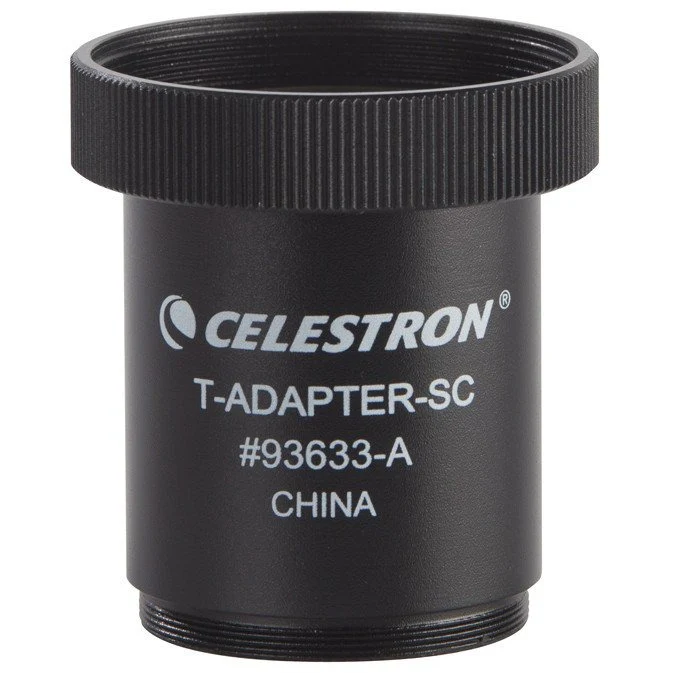
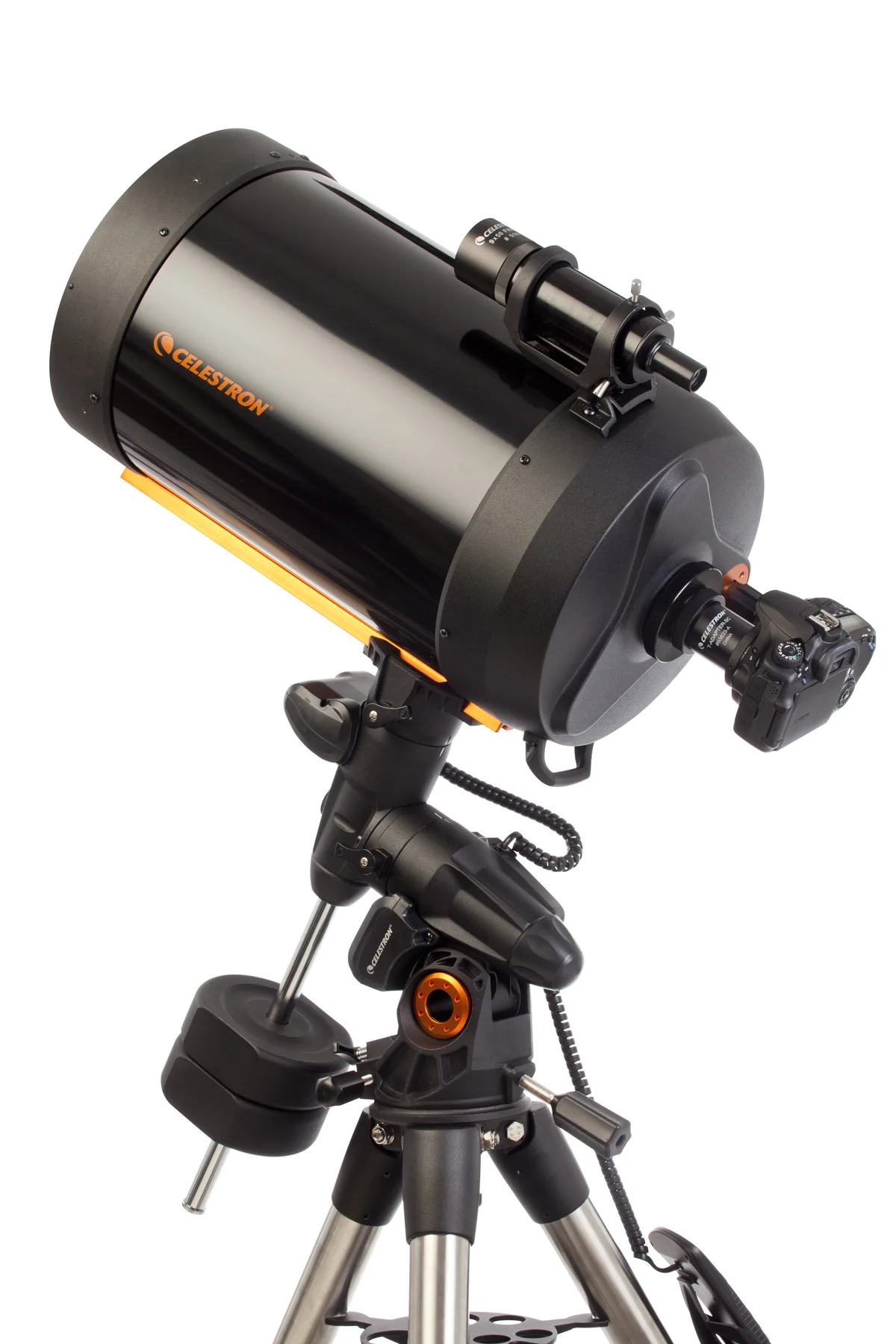
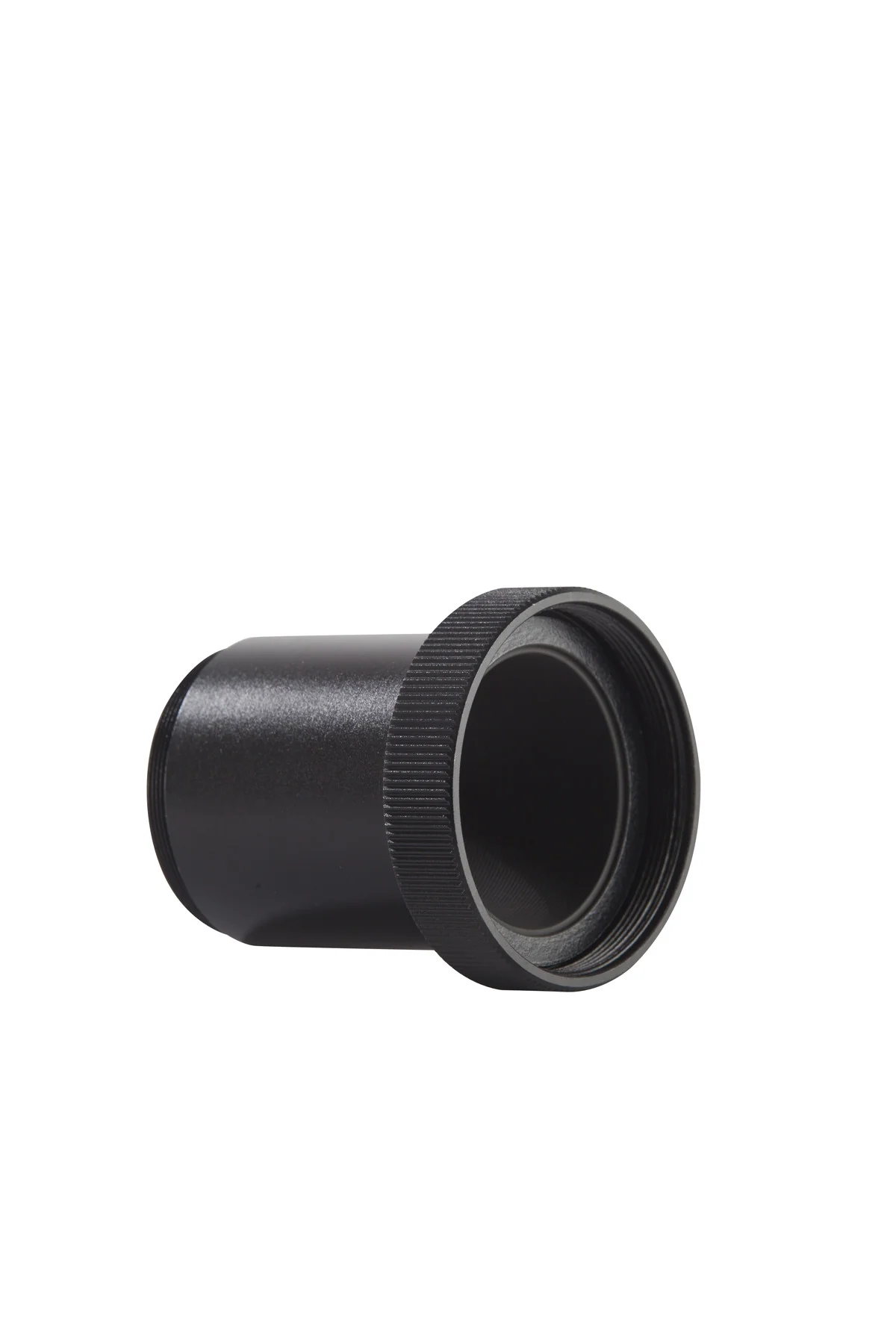
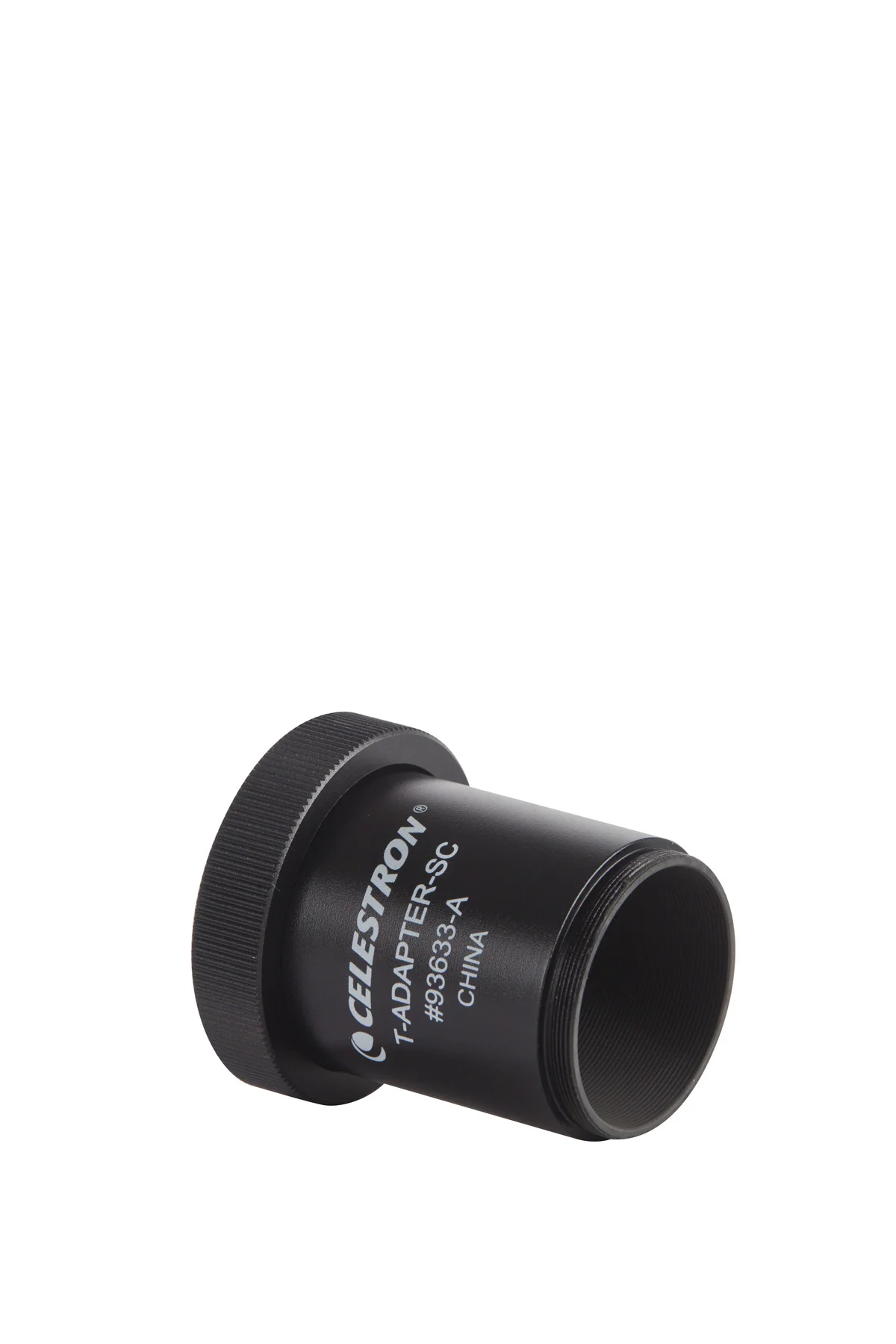
This sturdy metal T-Adapter is the accessory of choice if you’d like to attach an SLR or DSLR camera to the rear cell threads of a Schmidt-Cassegrain telescope for prime focus photography.
To get started, you’ll need the appropriate T-Ring for your camera body (#93402 for Nikon & #93419 for Canon EOS). Remove the lens from your camera and attach the T-ring in its place. Since the T-ring is camera-brand specific, it will snap right on just like a lens. Next, remove the diagonal and visual back from the rear cell of your telescope. Screw the Celestron T-Adapter onto the rear cell threads until secure. Now, thread the T-ring & camera onto the T-Adapter. That’s all there is to it. The camera is now using your telescope as a giant telephoto lens. The magnification will depend on the telescope’s focal length. For instance, a 300 mm camera lens is considered to be pretty powerful, right? Well, if you are using an 8” SCT at prime focus, you’ve got yourself a 2000 mm lens with a lot of light-gathering capability!
Prime focus photography is popular for short exposure images of terrestrial objects as well as celestial objects like the Moon. If you want to do longer exposures of deep sky objects with this method, we suggest using a separate guidescope or off-axis guider and an equatorial mount.
Original: $34.95
-65%$34.95
$12.23More Images
T-Adapter for Schmidt-Cassegrain Telescopes
This sturdy metal T-Adapter is the accessory of choice if you’d like to attach an SLR or DSLR camera to the rear cell threads of a Schmidt-Cassegrain telescope for prime focus photography.
To get started, you’ll need the appropriate T-Ring for your camera body (#93402 for Nikon & #93419 for Canon EOS). Remove the lens from your camera and attach the T-ring in its place. Since the T-ring is camera-brand specific, it will snap right on just like a lens. Next, remove the diagonal and visual back from the rear cell of your telescope. Screw the Celestron T-Adapter onto the rear cell threads until secure. Now, thread the T-ring & camera onto the T-Adapter. That’s all there is to it. The camera is now using your telescope as a giant telephoto lens. The magnification will depend on the telescope’s focal length. For instance, a 300 mm camera lens is considered to be pretty powerful, right? Well, if you are using an 8” SCT at prime focus, you’ve got yourself a 2000 mm lens with a lot of light-gathering capability!
Prime focus photography is popular for short exposure images of terrestrial objects as well as celestial objects like the Moon. If you want to do longer exposures of deep sky objects with this method, we suggest using a separate guidescope or off-axis guider and an equatorial mount.
Product Information
Product Information
Shipping & Returns
Shipping & Returns
Description
This sturdy metal T-Adapter is the accessory of choice if you’d like to attach an SLR or DSLR camera to the rear cell threads of a Schmidt-Cassegrain telescope for prime focus photography.
To get started, you’ll need the appropriate T-Ring for your camera body (#93402 for Nikon & #93419 for Canon EOS). Remove the lens from your camera and attach the T-ring in its place. Since the T-ring is camera-brand specific, it will snap right on just like a lens. Next, remove the diagonal and visual back from the rear cell of your telescope. Screw the Celestron T-Adapter onto the rear cell threads until secure. Now, thread the T-ring & camera onto the T-Adapter. That’s all there is to it. The camera is now using your telescope as a giant telephoto lens. The magnification will depend on the telescope’s focal length. For instance, a 300 mm camera lens is considered to be pretty powerful, right? Well, if you are using an 8” SCT at prime focus, you’ve got yourself a 2000 mm lens with a lot of light-gathering capability!
Prime focus photography is popular for short exposure images of terrestrial objects as well as celestial objects like the Moon. If you want to do longer exposures of deep sky objects with this method, we suggest using a separate guidescope or off-axis guider and an equatorial mount.